
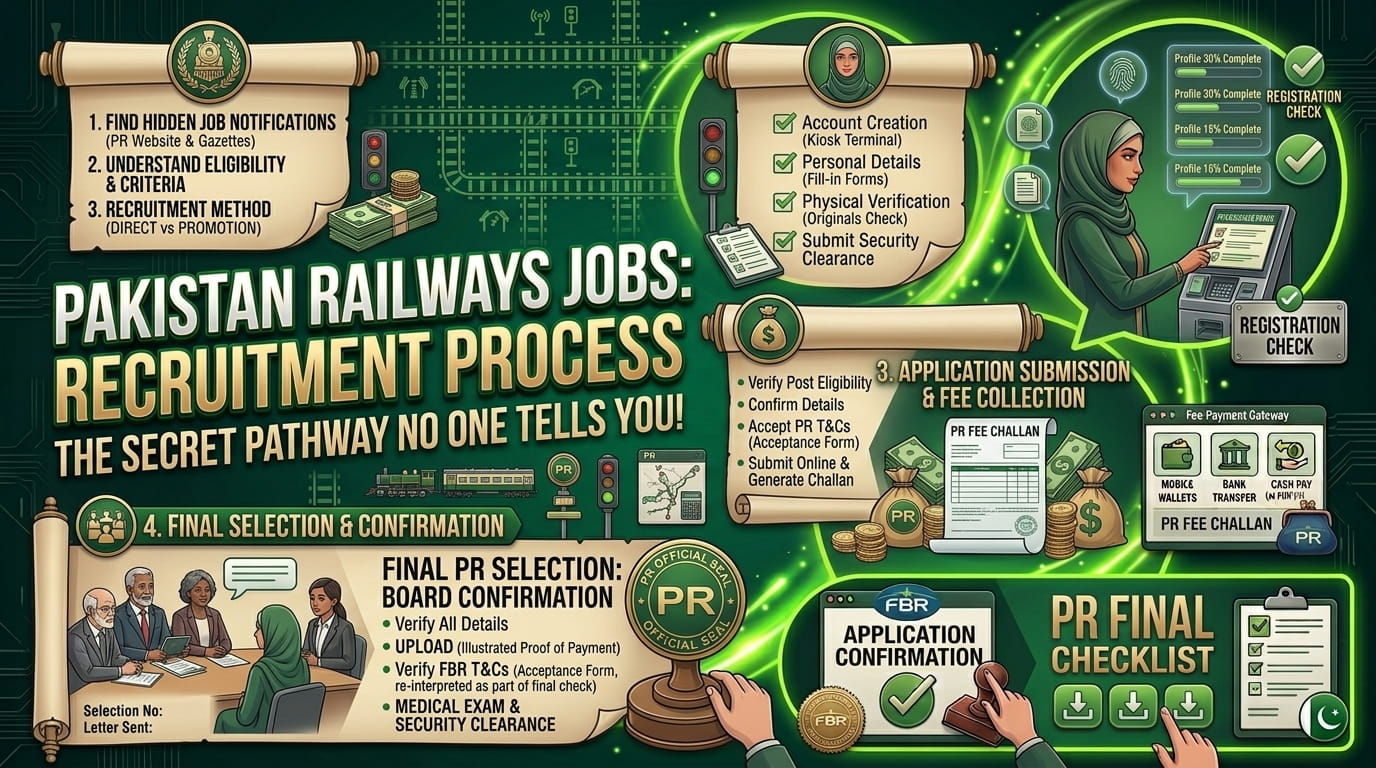
Try this yourself: search “Pakistan Railways jobs apply” and count how many different websites show up telling you to apply in completely different places — Railways’ own portal, FPSC, PTS, NTS. None of them agree, and most articles just say “apply on the official site” like that settles it. It doesn’t, and that vagueness is exactly why so many genuinely qualified applicants miss their actual window.
First — Understand Why Railways Hiring Feels So Scattered
This is genuinely the core confusion, so let’s clear it up first. Pakistan Railways doesn’t run one single, centralized hiring channel. Depending on the specific recruitment drive, you might see:
- Direct hiring through Railways’ own portal (pakrail.gov.pk) for certain announcements
- FPSC-administered posts for higher-grade administrative and management roles (BS-16 and above)
- PTS (Pakistan Testing Service) handling applications for some drives, where you download a form and submit it directly to PTS Islamabad
- NTS/OTS-administered written tests for various technical and clerical posts, especially for the larger recruitment waves
- National Job Portal (njp.gov.pk) listing and sometimes routing applications for various Railways vacancies alongside other government postings
Which one applies to you depends entirely on which specific advertisement and post you’re targeting — there’s no shortcut here except reading each advertisement carefully to see which testing body it names.
What Roles Actually Open Up
Railways hiring covers a genuinely huge range, more than people expect:
Technical/Trade roles — Welder, Skilled Filter Auto Diesel, Foreman, Electrical Engineer, and various workshop and signal-operation trade posts. These often specify a Matric 2nd Division with a relevant diploma or trade certificate from a recognized institute as the core requirement.
Apprentice programs — structured technical apprentice recruitment specifically tied to workshop divisions (Moghalpura) and signal shops, a genuinely solid entry point for trade-qualified candidates wanting hands-on rail engineering exposure.
Administrative/Clerical roles — Data Entry Operator and similar posts, generally requiring Intermediate or Bachelor’s level qualification depending on the specific post.
Operational roles — Railway TC (Ticket Checker), Railway Police, transport and passenger service roles.
Management/Higher-grade roles — handled through FPSC specifically, requiring Bachelor’s/Master’s level qualification depending on the grade.
Step-by-Step: How to Actually Apply
Step 1: Check Pakistan Railways’ own site first for the initial announcement.
Step 2: Identify the correct application channel named in that specific advertisement.
Read carefully — the ad will specify whether you apply directly through Railways’ own address, download and submit a PTS form to their Islamabad office, or apply through NTS/OTS or the National Job Portal. Don’t assume it’s the same channel as a previous recruitment cycle you might have heard about — this genuinely varies drive to drive.
Step 3: Confirm your eligibility, especially for trade posts.
For technical/trade roles specifically, the qualification requirement is trade-focused, not generic — Matric with a specific diploma or certificate from a recognized institute in that exact trade. A generic Matric alone typically isn’t enough for these specialized posts; the diploma/certificate is often the actual qualifying credential.
Step 4: Check the provincial/regional quota for your target post.
Recruitment happens across Pakistan — Karachi, Lahore, Hyderabad, Islamabad, Multan, Faisalabad, Rawalpindi, and other divisions — but seats are allocated by provincial/regional quota stated in each job notice. Confirm you’re eligible based on your domicile before applying, same as most other federal recruitment.
Step 5: Ensure your academic documents match your application exactly.
This is a specific, repeated caution worth taking seriously — ensure all academic details you provide match your original transcripts precisely, since mismatches are a common, avoidable reason for disqualification during later verification stages.
Step 6: Prepare for the written test through whichever agency is administering it.
If it’s NTS/OTS, prepare using their standard pattern (General Knowledge, English, subject-relevant questions). If it’s FPSC (for higher-grade posts), treat it with the same seriousness as any other FPSC exam — past papers and structured prep matter here too.
Step 7: Attend any physical/skill test required for your specific post.
For trade roles like Welder or similar hands-on technical posts, expect a physical or practical skill test in addition to the written stage — this genuinely tests your actual trade competency, not just theoretical knowledge.
Step 8: Complete the interview and medical examination stages.
Shortlisted candidates who clear the written and skill test stages move to a final interview, followed by a medical examination — standard for most government operational and technical roles given the physical nature of a lot of railway work.
A Real Example Worth Knowing
One of the more concrete recent drives Adeel found while searching: 329 apprentice positions specifically for the Workshops Division at Moghalpura and Signal Shops Lahore — genuinely practical, skill-based openings, not vague administrative posts, aimed specifically at trade-diploma holders wanting real hands-on rail engineering experience. Separately, broader recruitment waves have covered posts like Data Entry Operator, Welder, and Electrical Engineer spread across multiple divisions nationwide — showing the genuinely wide range active at any given time, from workshop trades to office-based technical roles.
Common Mistakes People Make
Assuming there’s one central application channel. As covered extensively above, this is the single biggest, most common confusion — always check the specific advertisement for the correct channel (Railways’ own portal, PTS, NTS/OTS, or National Job Portal).
Applying for trade posts without the specific required diploma/certificate. A generic educational qualification without the trade-specific credential named in the ad gets filtered out early.
Ignoring the provincial/regional quota. Confirm your domicile matches the quota for your specific target post and division before applying.
Mismatched academic documents. Double-check every detail you enter against your original transcripts — this is explicitly flagged as a common disqualification reason.
Not preparing for the physical/skill test stage for trade roles. Written test prep alone isn’t enough for hands-on technical posts — actual trade competency gets tested directly.
Relying on outdated third-party listings. As with most Pakistani government recruitment, a lot of recycled old advertisement content circulates online — always confirm current details and deadlines against Railways’ own site or the specific testing agency’s portal.
What to Realistically Expect
Pakistan Railways positions generally offer the standard government-sector package — stable income, pension benefits, and long-term career growth, genuinely appealing for candidates prioritizing job security over higher private-sector pay. Trade and technical posts particularly suit candidates who already have relevant diploma-level training and want real, hands-on engineering/maintenance work rather than a purely office-based role. The process timeline varies by which agency handles your specific post’s testing, but generally follows a similar multi-month pattern to other federal recruitment — screening, written test, skill/physical test where applicable, interview, and medical exam.
Final Thoughts
Pakistan Railways recruitment genuinely is one of the more scattered, harder-to-navigate government hiring systems in Pakistan — not because the actual jobs are complicated, but because figuring out which portal to even apply through takes real attention each time. The fix isn’t complicated though: read every specific advertisement fully, identify the named testing channel before doing anything else, and treat trade-specific qualification requirements as non-negotiable rather than assuming a general degree covers it.
Adeel’s honest advice now, after finally understanding the system on his second attempt: “Sabse pehle yeh dekho ke advertisement mein kis agency ka naam likha hai — baaki sab uske baad aata hai.” First thing to check is which agency’s name is written in the advertisement — everything else comes after that. Simple advice, but it’s genuinely the one thing that would’ve saved him a wasted first attempt.
Official resources worth bookmarking:
- Pakistan Railways Official Website: https://www.pakrail.gov.pk
- FPSC (for higher-grade posts): https://www.fpsc.gov.pk
- National Job Portal: https://njp.gov.pk