
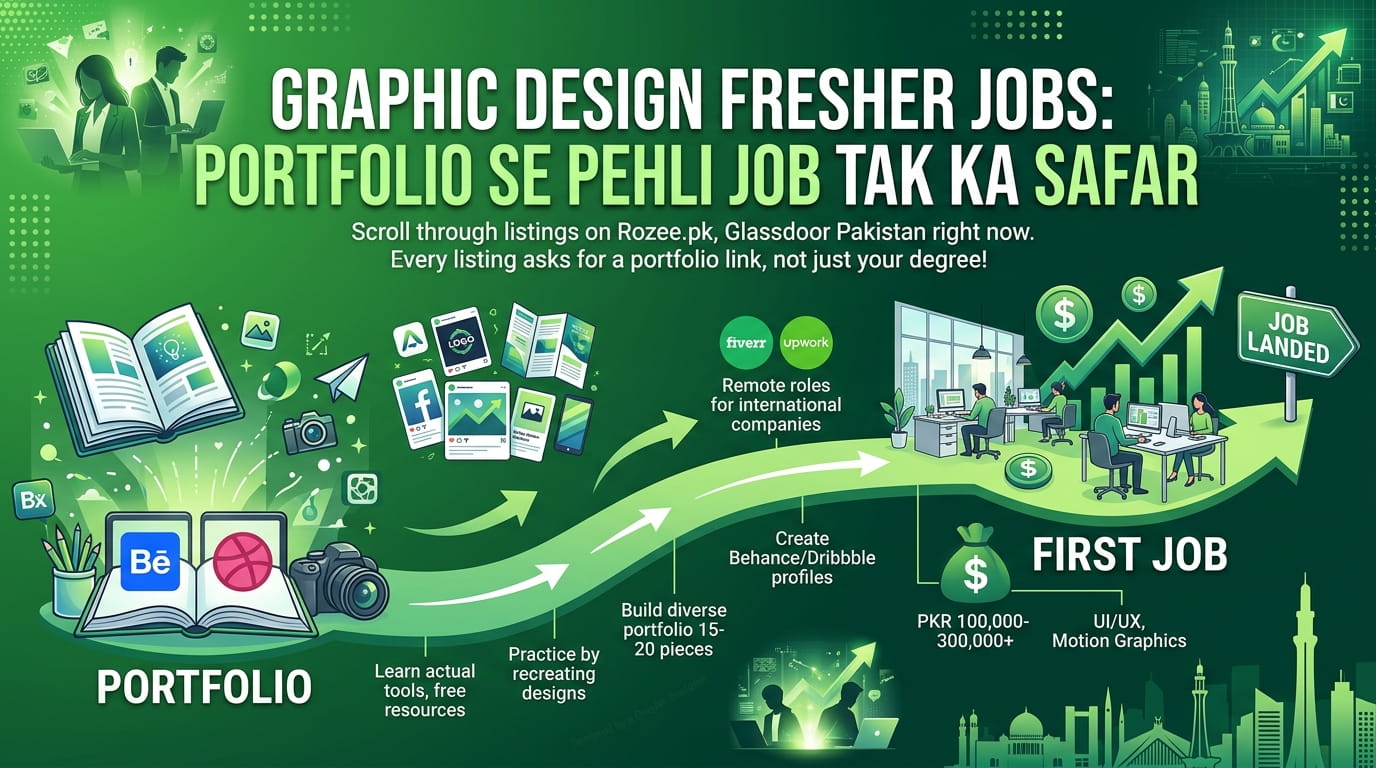
Scroll through any “graphic designer needed” listing on Rozee.pk or Glassdoor Pakistan right now, and notice what almost every single one asks for first — not your degree, not your university name. A portfolio link. That one detail changes the entire game plan for breaking into this field, and it’s exactly what a lot of fresh design graduates get wrong by leading with their CV instead.
Understand This Upfront — Your Degree Isn’t the Gatekeeper Here
Graphic design is genuinely one of the more accessible creative careers in Pakistan precisely because a formal degree isn’t the hard requirement it is in fields like engineering or medicine. Some job listings do ask for a Bachelor’s in Graphic Design or Fine Arts, but plenty of working designers — including some of the top freelancers on Fiverr and Upwork — are entirely self-taught, having built their actual skill through free tutorials and consistent practice.
What genuinely gates entry is proof of skill — a well-curated Behance profile or personal portfolio site gets you hired faster than a degree certificate on its own, across nearly every listing you’ll find.
The Realistic Career Paths Open to You
Advertising/marketing agencies — the most common entry point for fresh designers, working on client campaigns across print and digital, typically starting around PKR 25,000-40,000/month.
In-house design roles — companies (e-commerce brands, software houses, retail chains) hiring a designer directly for their own marketing/social media needs, similar starting range.
Freelancing on Fiverr/Upwork — genuinely viable even as a fresher, though local-client freelance income starts modest; the real earning jump comes once you land international clients paying in dollars.
Remote roles for international companies — increasingly common, and these pay noticeably better than local salaried positions, sometimes PKR 100,000-300,000+/month once you’re established with a strong enough portfolio.
Step-by-Step: How to Actually Build Toward Your First Job
Step 1: Learn the actual tools properly, using free resources.
Adobe Photoshop and Illustrator remain the industry standard, with Canva as a genuinely beginner-friendly starting point for simpler work. YouTube channels and platforms like Coursera and Udemy cover this thoroughly for free or cheap — local options like PSDF (Punjab Skills Development Fund), NAVTTC, and various private training centers also run affordable structured courses if you prefer guided learning over self-teaching.
Step 2: Practice by recreating designs you genuinely admire before creating original work.
This is a real, common technique — recreating an existing poster, social media post, or logo design teaches you the actual mechanics (spacing, typography, color choices) faster than starting from a blank canvas with no reference point.
Step 3: Build a portfolio of 15-20 varied pieces across different categories.
Logos, social media post designs, brochures, business cards, a sample brand identity — variety matters here because different employers and clients need different things, and a narrow portfolio limits which jobs you can credibly apply to.
Step 4: Create profiles on Behance and Dribbble — not just a folder on your laptop.
These platforms are where recruiters and clients actually search for talent, and Pakistani designers do get discovered directly through them. A personal portfolio website is a nice addition later, but Behance alone is genuinely enough to start.
Step 5: Start freelancing on Fiverr at modest rates specifically to build reviews.
Same principle as freelance writing or stock photography — price low initially to get your first few completed projects and reviews, then raise your rates gradually as your profile builds credibility.
Step 6: Apply directly to agencies and companies in your city, portfolio link front and center.
Every genuine listing wants to see your actual design work before anything else — lead your application with your Behance/portfolio link, not buried at the bottom of a CV.
Step 7: Consider a paid internship as a legitimate, common entry route.
Several current listings explicitly frame the internship as a chance to build a professional portfolio while working on real marketing campaigns — a genuinely solid way in if you’re struggling to land a full role straight away, though be clear on what the stipend and eventual conversion terms actually are before committing.
What Employers Are Actually Asking For Right Now
Looking at current listings gives a clearer, more honest picture than generic advice. Employers consistently want: proficiency in Adobe Creative Suite (Photoshop, Illustrator, and often InDesign), a strong portfolio showing real, varied work — not just class assignments, and increasingly, basic motion graphics or video editing familiarity (After Effects) as a genuine differentiator even at entry level. Understanding of typography, color theory, and layout fundamentals gets mentioned repeatedly too — this is core design literacy, not an advanced skill, so make sure you can actually speak to these concepts in an interview, not just apply them intuitively.
A Real Detail Worth Knowing: AI Isn’t Replacing This Field, It’s Reshaping It
Worth addressing directly since it’s a genuine, common worry among people considering this career now. Graphic design in Pakistan isn’t dying because of AI — it’s evolving, with growing demand specifically across e-commerce, digital marketing, and tech startups. Designers who actively learn to work alongside AI tools (Midjourney, Adobe Firefly, AI-enhanced Photoshop workflows) rather than ignoring them are positioning themselves better for the next several years, not worse. If you’re building your skillset now, factor this in — it’s a genuine advantage to lean into, not something to avoid out of anxiety.
What to Realistically Expect Salary-Wise
Be honest with yourself about the starting range, since a lot of casual advice inflates this. Fresh graduates and interns commonly start around PKR 15,000-25,000/month, with many beginning as interns at the lower end of that before converting to full-time. Entry-level roles with a bit more experience or a stronger portfolio can reach PKR 25,000-40,000/month at agencies. The real jump happens once you specialize — UI/UX design, motion graphics, or brand identity work — or once you successfully transition into freelancing for international clients, where earnings commonly land in the $500-3,000/month range (roughly PKR 140,000-840,000 depending on exchange rate) for designers with a genuinely strong Behance portfolio and consistent five-star reviews.
Common Mistakes Fresh Designers Make
Applying with just a CV, no portfolio link included. As covered above, this is the single fastest way to get skipped over — every legitimate listing wants to see actual work first.
Building a narrow portfolio around only one style or category. A portfolio full of only logos, or only social media posts, limits which roles you can credibly apply for — build genuine variety.
Underpricing freelance work indefinitely. Starting low on Fiverr to build reviews is smart; staying at that rate for years after you’ve built a real portfolio and client base isn’t.
Ignoring motion graphics and basic video editing entirely. A growing number of listings mention this as a genuine plus even at entry level — even basic After Effects familiarity meaningfully differentiates you from candidates who only know static design.
Not specializing as you gain experience. Staying a generalist indefinitely caps your earning ceiling — designers who move into UI/UX, motion graphics, or brand identity work specifically tend to see meaningfully higher pay ranges than generalist social-media-post designers.
Assuming a degree alone will get you hired. As covered at the start — the portfolio does the actual convincing here, not the certificate.
Final Thoughts
Graphic design remains one of the more genuinely accessible creative fields to break into in Pakistan — no gatekeeping degree requirement, real demand across growing sectors, and a clear, learnable path from zero skill to a working portfolio using mostly free resources. The actual work is building that portfolio seriously before you start applying, treating your Behance profile as your real resume, and being honest with yourself about starting salary expectations while you build toward the specializations and freelance opportunities that genuinely pay well.
Useful platforms and resources worth bookmarking:
- Behance (build your portfolio here): https://www.behance.net
- Dribbble: https://dribbble.com
- Rozee.pk (local listings): https://www.rozee.pk
- Fiverr (freelancing): https://www.fiverr.com
- Upwork (international clients): https://www.upwork.com