
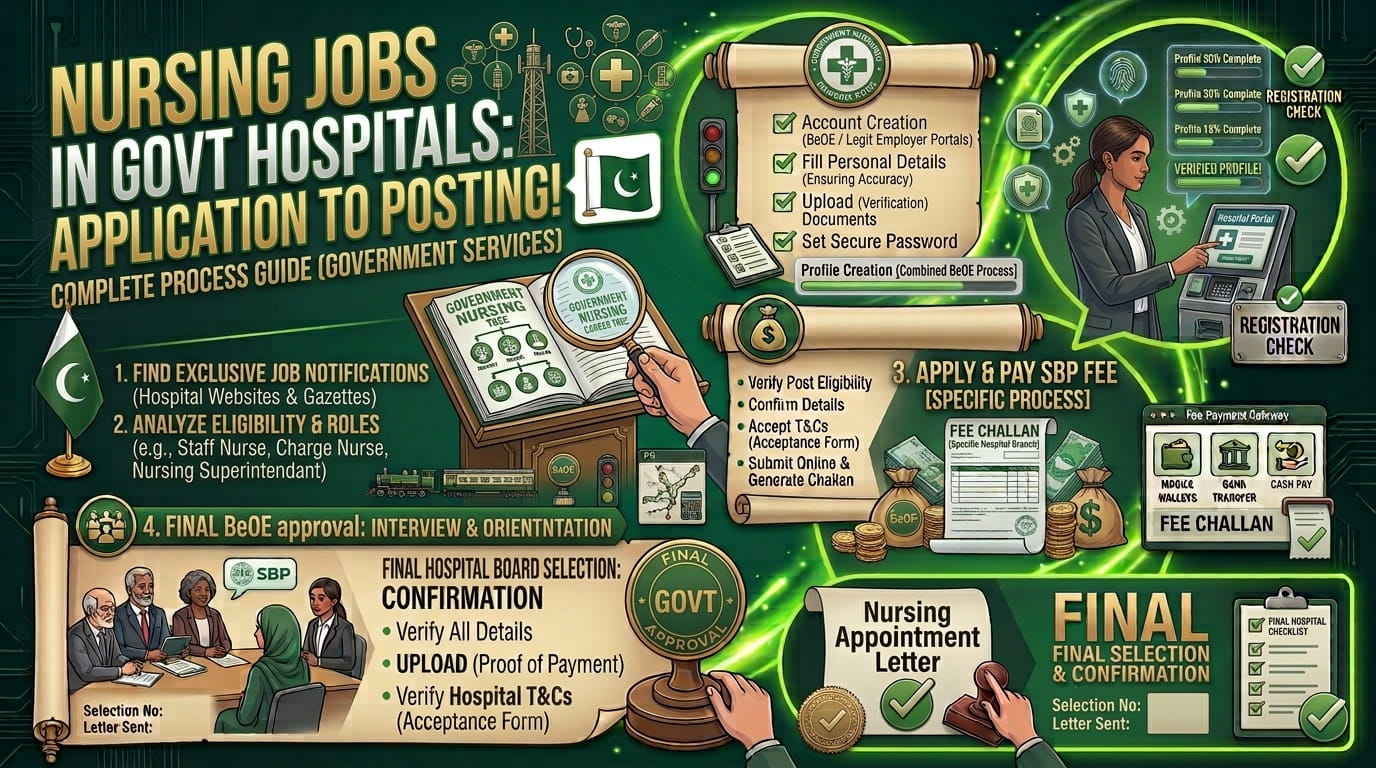
Here’s a question that trips up almost every fresh nursing graduate I’ve come across: can you apply to a government hospital job the day you finish your BSc Nursing? The honest answer is no — not without one specific document sorted first, and it’s not your degree. Most people find this out the hard way, mid-application, staring at a portal that won’t let them proceed.
Step 1: Get Your PNC Registration Sorted First — Before Anything Else
This is non-negotiable, and it’s exactly where Sana’s confusion started. Every single government (and most private) nursing job listing explicitly requires valid registration with the Pakistan Nursing Council (PNC) — sometimes referred to as PNMC (Pakistan Nursing & Midwifery Council) depending on the specific province/listing. Without this, you genuinely cannot apply anywhere formally, regardless of how good your actual degree or diploma is.
Get this registered as soon as you complete your nursing qualification — Diploma in General Nursing or BSc Nursing (BScN) from a recognized institute — since processing this takes time, and you don’t want it holding up your application when an actual vacancy opens.
Understanding the Different Routes Into Government Nursing Jobs
This is where it gets genuinely useful to know upfront, because government nursing recruitment doesn’t run through one single channel — it splits by which level of government hospital you’re targeting.
Federal hospitals (like PIMS, Islamabad) — recruited through FPSC, following the same structured process as any other federal government post: online application through FPSC’s portal, written test/screening, and interview, all tied to a specific FPSC advertisement number.
Provincial hospitals (DHQ, THQ, teaching hospitals under provincial health departments) — recruitment typically runs through the hospital’s own recruitment committee or the provincial Public Service Commission (PPSC in Punjab, similarly for other provinces), depending on the post grade and specific hospital’s own advertisement process.
Military/Armed Forces hospitals — through AFNS (Armed Forces Nursing Services), a completely separate, specialized track specifically for eligible female candidates, requiring FSc Pre-Medical background alongside your BSc Nursing/BS Nursing qualification, offering a genuinely different career structure (military service terms, structured training, accommodation).
Step-by-Step: How to Actually Apply
Step 1: Confirm your PNC/PNMC registration is active and valid.
As covered above — this comes before everything else. Keep your registration certificate scanned and ready, since it’s requested at multiple stages, not just at initial application.
Step 2: Identify which specific channel your target hospital recruits through.
Check whether the hospital you’re interested in is federal (FPSC route) or provincial (hospital’s own portal or provincial PSC). Sana’s target was a provincial teaching hospital, so she specifically watched that hospital’s own career page and the relevant provincial health department’s announcements, rather than checking FPSC.
Step 3: Read the specific advertisement’s eligibility carefully.
This genuinely varies — some posts specifically want a Diploma in General Nursing, others specifically require BSc Nursing, and some accept either. Age limits also vary but commonly fall somewhere around 21-35 years for staff nurse posts. Match your qualification to the exact listed requirement before applying.
Step 4: Prepare your full document set in advance.
Commonly required: updated CV, educational certificates (nursing diploma/degree transcripts), your valid PNC registration/license, CNIC, and any relevant work experience documents if you have prior clinical experience. Sana’s advice from her own process: get everything scanned properly in the specified file format and size before the application portal opens — scrambling to scan documents under a tight deadline wastes real time.
Step 5: Apply through the correct official portal.
For hospital-specific or provincial recruitment, this is typically the hospital’s own application form or portal (often linked through the provincial health department’s website — for example, Punjab’s is under health.punjab.gov.pk). For federal hospitals like PIMS, it’s directly through FPSC’s portal.
Step 6: Pay the application fee if required, and submit before the deadline.
Fee requirements and amounts vary by specific advertisement — check the exact instructions on that particular posting rather than assuming a flat fee applies everywhere.
Step 7: Print/save your application confirmation receipt.
This matters more than people expect — Sana specifically kept hers for reference when she later needed to confirm her application status.
Step 8: Prepare for the actual selection process.
Shortlisted candidates typically go through a mix of written tests, nursing skill assessments, and interviews conducted by the hospital’s own recruitment committee (for provincial/hospital-level posts) or FPSC’s standard multi-stage process (for federal posts). Sana’s actual experience included a written test covering general nursing knowledge and a practical skills assessment, followed by a panel interview focused on clinical scenarios and patient care judgment.
Step 9: Complete document verification and medical clearance if required.
Once selected, expect a formal document verification stage, and depending on the specific hospital/department, sometimes a medical fitness clearance before your final posting is confirmed.
Step 10: Receive your posting.
This is the part that surprised Sana most — you don’t necessarily choose your specific ward or department upfront. Initial posting is often decided by the hospital’s administration based on current staffing needs, though transfers/reassignments within the hospital become more possible once you’re established.
A Real Example Worth Sharing
Sana’s actual successful application: a Staff Nurse post at a provincial teaching hospital in Lahore, requiring BSc Nursing with valid PNC registration, age bracket 21-35. She applied online through the hospital’s linked provincial health portal, submitted her full document set, and went through a written test plus practical skills assessment, followed by a panel interview. Starting salary fell somewhere in the PKR 70,000-120,000/month range depending on grade and qualification level — genuinely solid by government-sector standards, reflecting the specialized nature of nursing qualifications. The whole process, from application to confirmed posting, took a few months.
The Army Nursing (AFNS) Alternative Worth Knowing
If you’re specifically interested in a more structured, military-adjacent nursing career, AFNS (Armed Forces Nursing Services) is a genuinely distinct path worth knowing about. Eligibility requires being a female Pakistani citizen with FSc Pre-Medical background at the required marks, plus BS/BSc Nursing from a recognized institution and valid PNC registration. The selection process is more elaborate than standard hospital recruitment — registration, written test, intelligence test, medical examination, interview, and final merit selection — leading to postings in Pakistan Army hospitals nationwide, with professional training, attractive salary packages, medical facilities, and accommodation as per rules. This is a genuinely different career track from civilian government hospital nursing, with its own distinct service terms and structure.
Common Mistakes People Make
Not getting PNC/PNMC registration sorted before applying. As covered extensively above — this is the absolute first step, and skipping or delaying it blocks you from applying anywhere formally.
Confusing federal and provincial recruitment channels. Applying through FPSC for a provincial hospital post (or vice versa) wastes your application — always confirm which body handles that specific hospital’s recruitment.
Mismatching qualification level to the specific post’s requirement. Diploma versus BSc Nursing requirements genuinely vary post to post — read the exact line in each advertisement.
Submitting incomplete or improperly formatted documents. As with most Pakistani government-adjacent recruitment, scanned documents in the wrong format or size can get an application rejected outright at the screening stage.
Assuming you’ll choose your ward/department from day one. Initial posting is typically based on the hospital’s staffing needs, not personal preference — go in with realistic expectations, with flexibility possible later as you build tenure.
Overlooking specialized tracks like AFNS. If a more structured, military-adjacent nursing career appeals to you, this is a genuinely distinct and worthwhile path to research separately from standard civilian hospital recruitment.
What to Realistically Expect
Government nursing salaries genuinely offer solid, stable compensation relative to many other entry-level government roles, reflecting the specialized clinical training required — commonly somewhere in the PKR 70,000-120,000/month range for staff nurse posts, varying by grade, hospital, and qualification level, plus standard government benefits including medical coverage, pension, and structured career progression. Beyond pay, government hospital postings offer genuine long-term job security and a defined career ladder (Staff Nurse to Charge Nurse to Nursing Superintendent roles over time with experience), something that’s harder to build as clearly in a lot of private healthcare settings.
Final Thoughts
Nursing remains one of the more consistently in-demand, respected government career paths for qualified graduates in Pakistan — but the actual process has real, specific gatekeeping steps that aren’t obvious until you’re in it, starting with PNC registration and continuing through correctly identifying which recruitment channel (federal, provincial, or military) your target hospital actually uses. Get the registration sorted early, match your qualification carefully to each specific posting’s requirement, and prepare properly for the practical skills assessment stage — it’s not just a formality.
Sana’s honest reflection now, settled into her posting: “Sabse pehle maine socha degree hi kaafi hai. PNC registration na hoti to main kahin bhi apply hi nahi kar sakti thi.” At first she thought the degree alone was enough. Without PNC registration, she wouldn’t have been able to apply anywhere at all — and that’s genuinely the first, most essential lesson for anyone starting this path.
Official resources worth bookmarking:
- Pakistan Nursing Council: https://pnc.org.pk
- FPSC (for federal hospitals like PIMS): https://www.fpsc.gov.pk
- Provincial Health Department portals (e.g., Punjab): https://health.punjab.gov.pk
- Pakistan Army AFNS Recruitment: https://www.joinpakarmy.gov.pk