
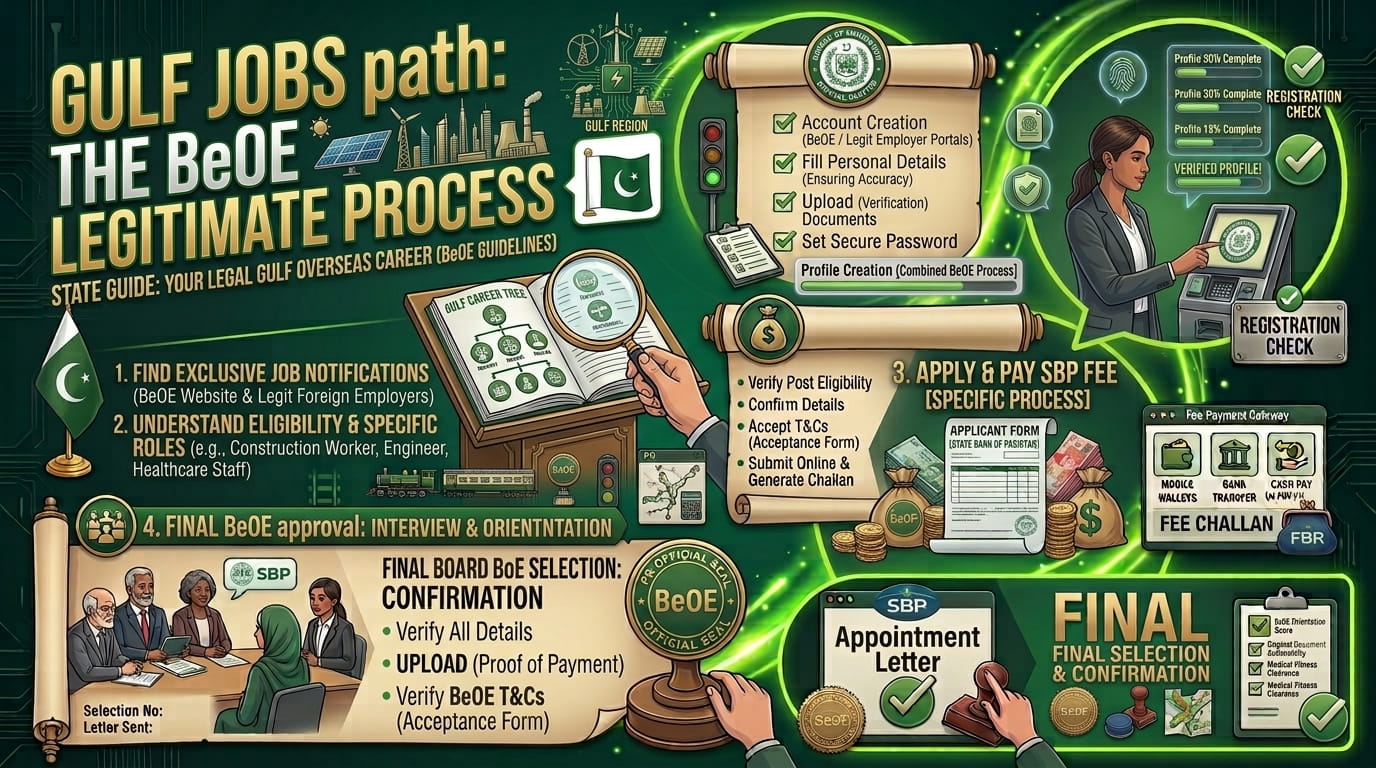
Every year, thousands of Pakistanis hand over their life savings to someone calling themselves a “recruitment agent” for a Gulf job that either never existed or never paid what was promised. And every year, the actual legal system that could’ve protected them sits there, publicly documented, mostly unused — simply because nobody explained it clearly before the money changed hands.
First — Understand the Government Body That’s Supposed to Protect You
The Bureau of Emigration & Overseas Employment (BE&OE) is the actual federal government body overseeing all legal overseas employment from Pakistan — operating since 1971, and it’s issued genuine, protected overseas employment to over 10 million Pakistani emigrants since inception. It works under the Ministry of Overseas Pakistanis & Human Resource Development, and its core job is exactly what protected my chacha and what would’ve protected our other relative if he’d gone through the right channel — regulating who’s allowed to legally recruit Pakistanis for jobs abroad, and giving you legal recourse if something goes wrong.
Two Real, Legal Paths — Know the Difference
Path 1: Through a Licensed Overseas Employment Promoter (OEP)
This is the formal recruitment agency route. Licensed OEPs advertise foreign jobs in newspapers or through their offices, and they’re legally required to be registered with BE&OE — each one carries a specific OEPL number (Overseas Employment Promoter License number), which you can and should verify.
Path 2: Direct Employment
Through relatives, friends, or contacts already working/living abroad, or increasingly through legitimate direct job postings online. Even in this path, you still need to go through BE&OE’s protection process before departure — this isn’t optional just because you found the job yourself.
Step-by-Step: How to Actually Do This Legally and Safely
Step 1: If going through an agency, verify their OEPL license number before doing anything else.
This is genuinely the single most important protective step, and it’s exactly what our family’s scammed relative skipped. Every legitimate recruitment agency has a specific OEPL number. Check BE&OE’s website directly (https://beoe.gov.pk) for their list of licensed Overseas Employment Promoters and cross-check the specific agency’s license status before paying anything or signing anything.
Step 2: Check BE&OE’s site for active complaint notices against that specific agency.
This is something most people don’t know exists, and it’s genuinely valuable. BE&OE publicly posts personal hearing notices, show-cause notices, and complaint cases against specific agencies by their OEPL number and city — right on their website. Before committing to any agency, search their name and license number against these public notices. If an agency has multiple active complaints or is facing license action, that’s a real, verifiable red flag, not just a rumor.
Step 3: Understand what “Protection” actually means and why it’s non-negotiable.
Under the Emigration Ordinance 1979, every Pakistani proceeding abroad on a work visa must obtain Protection — this is the Foreign Service Agreement (FSA) signed between you and your foreign employer/OEP, which then gets counter-signed by the Protectorate of Emigrants. This is legally what ensures your contract’s terms actually get enforced, and it’s what gives you a formal path to complain if the employer violates the agreement once you’re abroad.
Step 4: Prepare and submit your registration documents to your nearest Protectorate of Emigrants office.
BE&OE has Protectorate of Emigrants offices across the country — the process starts with submitting your documents for registration and verification, whether you came through an OEP or found the job directly yourself.
Step 5: Gather the required documents properly.
Commonly required: your valid passport, the signed Foreign Service Agreement/contract, a Police Character Verification Certificate from your concerned DPO, and a Medical Fitness Report from an approved medical center for your destination country. Note specifically — affidavits from spouse/parents (for female workers) and driving licenses (for driver-trade applicants) are explicitly NOT required for registration against any trade, per BE&OE’s own published guidance — worth knowing this clearly so no agency can wrongly demand these from you as an extra hurdle.
Step 6: Attend document verification, then the mandatory briefing session.
After your documents are verified, you’re guided to the Briefing Hall for a proper orientation — covering health, legal rights, and other essential aspects of working abroad. This isn’t a formality to rush through; genuinely pay attention here, since it’s where you learn your actual rights as a protected emigrant.
Step 7: Get your registration number and Protector Sticker on your passport.
Once verified and briefed, your case gets forwarded to the Protector of Emigrants, who signs and embosses your passport, after which it’s returned to you along with your documents.
Step 8: Pay the prescribed government fee — now digitized.
Worth knowing: BE&OE recently launched a QR-based Cashless Fee Payment Mechanism in partnership with National Bank of Pakistan specifically to digitize and speed up this fee payment step — a genuinely useful, modern improvement over the older manual process.
Step 9: Keep your protection valid, and know how to renew it.
As long as your contract’s terms and conditions remain unchanged, your protection stays valid for that agreement. If terms change or you’re taking on a new contract, you need fresh protection — go back to the Protectorate of Emigrants office with the new agreement and required documents.
How to Actually Protect Yourself From Scams
Red flag: An “agent” with no verifiable OEPL number, or refusing to show it. Legitimate promoters are licensed and registered — there’s no legitimate reason for one to avoid confirming their license number when asked directly.
Red flag: Being asked to pay large sums before any formal contract or protection process begins. Legitimate recruitment fees follow a structure that BE&OE requires offices to display prominently — protectorate offices are specifically instructed to display the fee structure in bold at their entrance and premises. If an amount asked feels arbitrary, unclear, or unusually large before you’ve even seen a proper Foreign Service Agreement, that’s worth real caution.
Red flag: Skipping the Protectorate of Emigrants registration entirely. If anyone tells you that you don’t need to go through BE&OE’s protection process because it’s “not necessary” or “takes too long,” that’s exactly the kind of shortcut that leaves you with zero legal recourse if things go wrong abroad — this is precisely what happened with our family’s scammed relative.
Green flag: The agency actively directs you toward the Protectorate process rather than around it. A legitimate OEP wants your registration properly done, since it’s part of their own legal compliance too.
Use BE&OE’s own complaint and grievance system if something does go wrong. The Bureau maintains an active feedback and complaint mechanism specifically for overseas Pakistanis to report issues — and their website’s regularly updated complaint notices against various agencies show this system genuinely gets used and acted upon, not just theoretical.
What This Actually Looks Like in Practice
My chacha’s actual path: found his electrician position in Dubai through a properly licensed OEP referred by someone from our own town who’d used the same agency successfully before. He verified the OEPL number himself before committing, went through the full document verification and briefing process, got his Protector Sticker, and departed with a properly signed, protected Foreign Service Agreement. Eleven years, several contract renewals, zero major disputes — and on the one occasion an employer tried to alter agreed terms partway through a contract, having that formal, protected agreement gave him actual legal standing to push back, something an unprotected, informal arrangement never would have offered.
Common Mistakes People Make
Trusting an agent purely on word-of-mouth without verifying their OEPL license directly. Personal referrals help, but always independently confirm the license status yourself on BE&OE’s site.
Skipping the BE&OE registration/protection process because it “takes time.” This single shortcut is what strips away your legal protection entirely if something goes wrong — never skip it, regardless of how urgently an agent pushes you to.
Not checking BE&OE’s public complaint notices before committing to an agency. This free, publicly available resource genuinely surfaces real, documented problems with specific agencies — use it.
Paying unclear or excessive fees before a formal contract exists. Legitimate fee structures are meant to be displayed openly — don’t accept vague, undocumented payment demands.
Assuming direct employment (through a friend/relative abroad) doesn’t need BE&OE protection. Even self-arranged jobs abroad still require going through the Protectorate of Emigrants process before departure — this isn’t exclusive to agency-arranged jobs.
Final Thoughts
The legal path to Gulf and other overseas employment genuinely exists, is well-established, and is designed specifically to protect Pakistani workers — but it only works if you actually use it properly instead of trusting shortcuts from unverified agents chasing a quick commission. Verify OEPL licenses, insist on going through the Protectorate of Emigrants for proper Protection, and treat that formal Foreign Service Agreement as your genuine legal safety net, not paperwork to rush past.
My chacha’s advice to anyone considering this now: “Jaldi mein kabhi kisi agent pe andha bharosa mat karo — apna registration khud verify karo, apna protection khud lo.” Never blindly trust an agent out of urgency — verify your own registration, get your own protection. That one habit is genuinely the difference between a real career abroad and becoming another complaint listed on BE&OE’s website.
Official resources worth bookmarking:
- BE&OE Official Website: https://beoe.gov.pk
- Verify Licensed OEPs and check complaint notices: https://beoe.gov.pk/foreign-jobs
- Protectorate of Emigrants office listings: https://beoe.gov.pk/protectorate-of-emigrants