
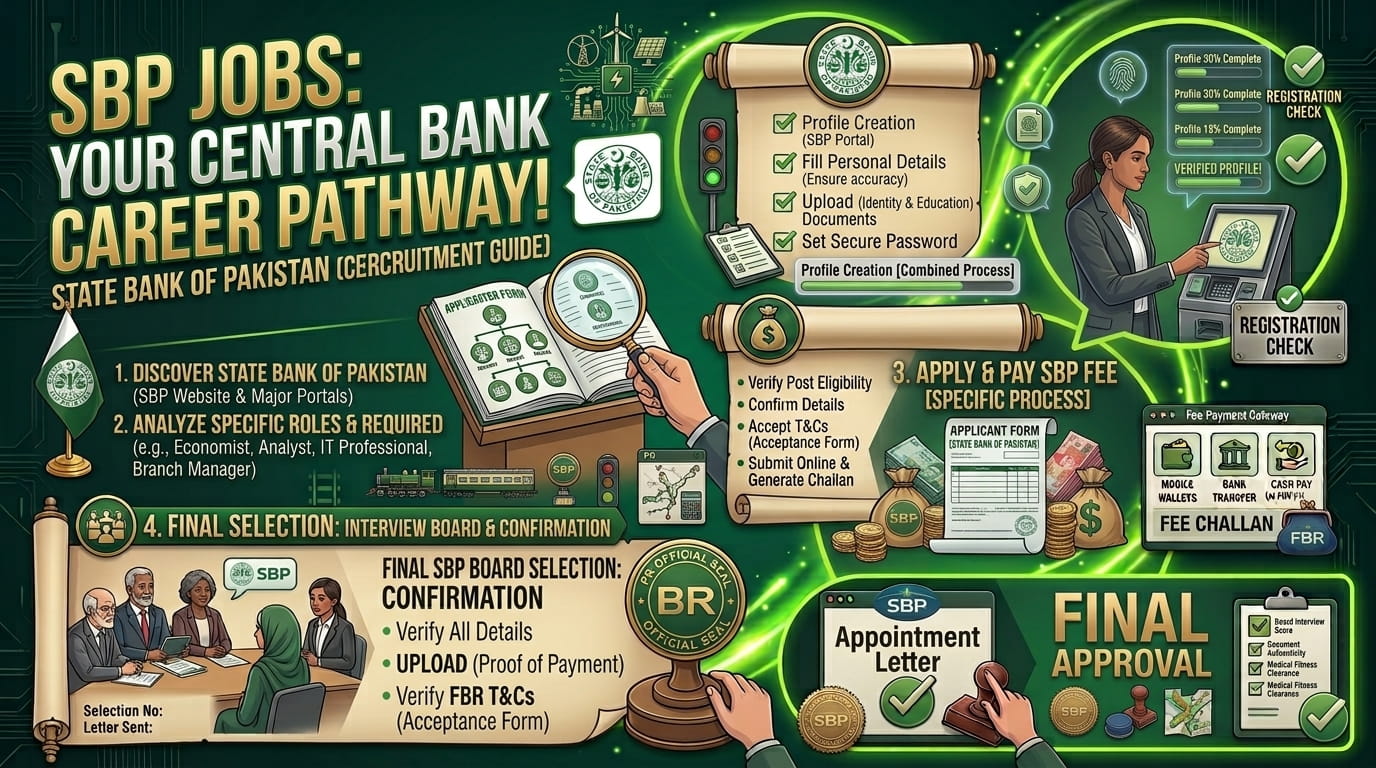
My university senior, Areeb, cleared SBOTS — the State Bank Officers Training Scheme — two batches back, and when I asked him what surprised him most about the actual process, his answer was immediate: “Log samajhte hain SBP normal bank hai, but yeh regulator hai, ekdum different level ka hiring process hai.” People assume SBP hiring works like any commercial bank’s MTO program. It genuinely doesn’t — it’s the central bank, the regulator overseeing every other bank in the country, and the selection process reflects that seriousness.
I sat with him through a good chunk of his prep and application process, and here’s the honest, complete picture of what it actually takes.
First — Understand SBP Isn’t “A Bank” the Way You’re Thinking
This is the mental shift Areeb had to make early on. State Bank of Pakistan is the country’s central bank — it doesn’t take public deposits or give out loans to individuals the way HBL or UBL does. It regulates monetary policy, oversees the entire banking system, manages foreign reserves, and increasingly handles digital payment infrastructure and financial technology policy. Headquartered in Karachi, with branch offices spread across 15 cities including Islamabad and the four provincial capitals.
This distinction matters because it shapes what SBP actually hires for — economists, policy analysts, banking supervisors, IT and digital finance specialists, statisticians, alongside more standard administrative and management roles.
The Main Entry Routes for Fresh Graduates
SBOTS (State Bank Officers Training Scheme) — This is the flagship, most prestigious entry route, and the one Areeb went through. It hires for Assistant Director (OG-2) level, positions based in Karachi, structured as permanent government-style employment with formal, numbered training batches (Areeb’s was a specific numbered batch, and each new cycle continues this numbering — currently well into the high-20s in recent cycles).
SOTS (Statistical Officers Training Scheme) — A parallel, more specialized track specifically for candidates with strong statistics/econometrics backgrounds, feeding into SBP’s data and research-heavy departments.
Departmental/Lateral hiring — Ongoing recruitment for specific roles as they open — Deputy Director, Data Analyst, Statistical Officer, and increasingly, roles tied to SBP’s Digital Innovation & Settlements Department (covering digital payment systems, banking technology, and fintech policy work), which reflects the central bank’s growing focus on modernizing Pakistan’s financial infrastructure.
Step-by-Step: How to Actually Apply
Step 1: Go directly to SBP’s official careers portal.
Step 2: Confirm your eligibility for the specific scheme or post.
For SBOTS-level entry roles: generally a Bachelor’s or Master’s degree (16 years of education) in a relevant field — Finance, Business Administration, Economics, Computer Science, Statistics, or related disciplines, depending on the specific batch’s stated requirement. Departmental roles (like the Digital Innovation & Settlements postings) may specify more targeted qualification and relevant professional experience requirements.
Step 3: Register and complete the online application accurately.
You’ll need your CNIC, email address, and personal/academic details ready. Areeb’s specific caution here: applications submitted in person or via email will not be entertained for SBOTS — everything goes through the official online portal only, no exceptions.
Step 4: Double-check every detail before submitting — incomplete applications simply don’t get considered.
This is stated explicitly in SBP’s own instructions — incomplete or incorrect applications may not be considered at all, not even flagged for correction. Read the full eligibility criteria and instructions on the portal carefully before you start filling anything in.
Step 5: Prepare seriously for a rigorous, multi-stage written test.
This is where SBOTS genuinely separates itself from a standard commercial bank’s MTO test. Areeb’s prep involved deep coverage of economics fundamentals, current monetary policy issues, general banking concepts, English composition, and quantitative/analytical reasoning — treated with a seriousness closer to CSS-level prep than a typical private bank’s entry test. He specifically mentioned that SBP’s own publications (Monetary Policy Statements, the SBP Annual Report) were genuinely useful prep material, since interview panels expect you to actually understand current Pakistani monetary policy context, not just textbook theory.
Step 6: Expect a genuinely rigorous panel interview.
Beyond standard “why do you want this job” questions, SBOTS interviews reportedly probe deep into your understanding of macroeconomic concepts, current banking sector issues, and sometimes scenario-based policy questions. Areeb’s advice: read recent SBP monetary policy announcements and understand the reasoning behind them — panels notice candidates who can discuss real, current policy context intelligently versus those reciting textbook definitions.
Step 7: Understand the training period structure once selected.
SBOTS inductees go through a formal, structured training program before full placement — genuinely more intensive and longer than typical private bank MTO training, reflecting the specialized, regulatory nature of central bank work.
A Real Detail Worth Knowing: Physical and Location Requirements
Worth flagging specifically — most SBP roles, including SBOTS, are explicitly office-based positions, distinctly different from physically-demanding uniformed government roles. That said, SBOTS specifically has historically been based in Karachi only for the training period, which is a genuine practical consideration if you’re not based there — factor in relocation planning early if you’re seriously pursuing this route.
What to Realistically Expect Salary and Benefit-Wise
SBP positions are genuinely known for offering some of the more competitive compensation packages among Pakistani government-adjacent institutions — a reflection of the specialized skill level required and the central bank’s importance to the financial system. Beyond base salary, benefits commonly include medical facilities for employees and eligible dependents, provident fund and retirement benefits, professional development and training opportunities, performance-based promotions, and in some cases, interest-free loan facilities for eligible employees — genuinely solid, comprehensive benefits by Pakistani public-sector standards.
Common Mistakes People Make
Underestimating the exam and interview’s depth. Treating SBOTS prep like a standard commercial bank MTO test is a common, costly mistake — the actual bar for economic and policy understanding runs considerably deeper.
Submitting applications through the wrong channel. As covered above, in-person or email submissions are explicitly rejected for SBOTS — online portal only, every time.
Leaving application details incomplete or inaccurate. SBP’s own stated policy is that incomplete/incorrect applications may simply not be considered — there’s no assumed follow-up correction process.
Not staying current on actual monetary policy and banking sector news. Interview panels genuinely expect candidates to engage with real, current context — reading SBP’s own Monetary Policy Statements and Annual Report gives you a real edge here that generic banking-exam prep content doesn’t.
Assuming Karachi-based roles are flexible on location. Confirm the specific location requirement for your target scheme/post before investing significant prep time, especially if relocating isn’t feasible for you.
Ignoring the SOTS track if your background is more statistics-focused. If your degree and interest lean more toward data, econometrics, or research rather than general finance/business, SOTS may genuinely be a better-fitting entry point than SBOTS.
Final Thoughts
A career at the State Bank of Pakistan is genuinely one of the more prestigious, intellectually demanding paths into Pakistan’s financial sector — but it asks for real depth of preparation in return, closer in spirit to a competitive civil service exam than a standard private bank’s graduate hiring process. The people who succeed here aren’t just strong students on paper — they’re candidates who’ve genuinely engaged with how Pakistan’s monetary and financial system actually works right now, not just in theory.
Areeb’s honest reflection looking back: “Maine socha achi banking knowledge kaafi hogi. Asal mein unhe pata karna tha ke main current policy samajhta hoon ya sirf ratta laga ke aaya hoon.” He thought solid banking knowledge alone would be enough. What they were actually testing for was whether he genuinely understood current policy, or had just memorized his way in. That distinction, once he understood it, changed how he prepared entirely.
Official portal to bookmark:
- SBP Careers Portal: https://www.sbp.org.pk/careers/status.asp