
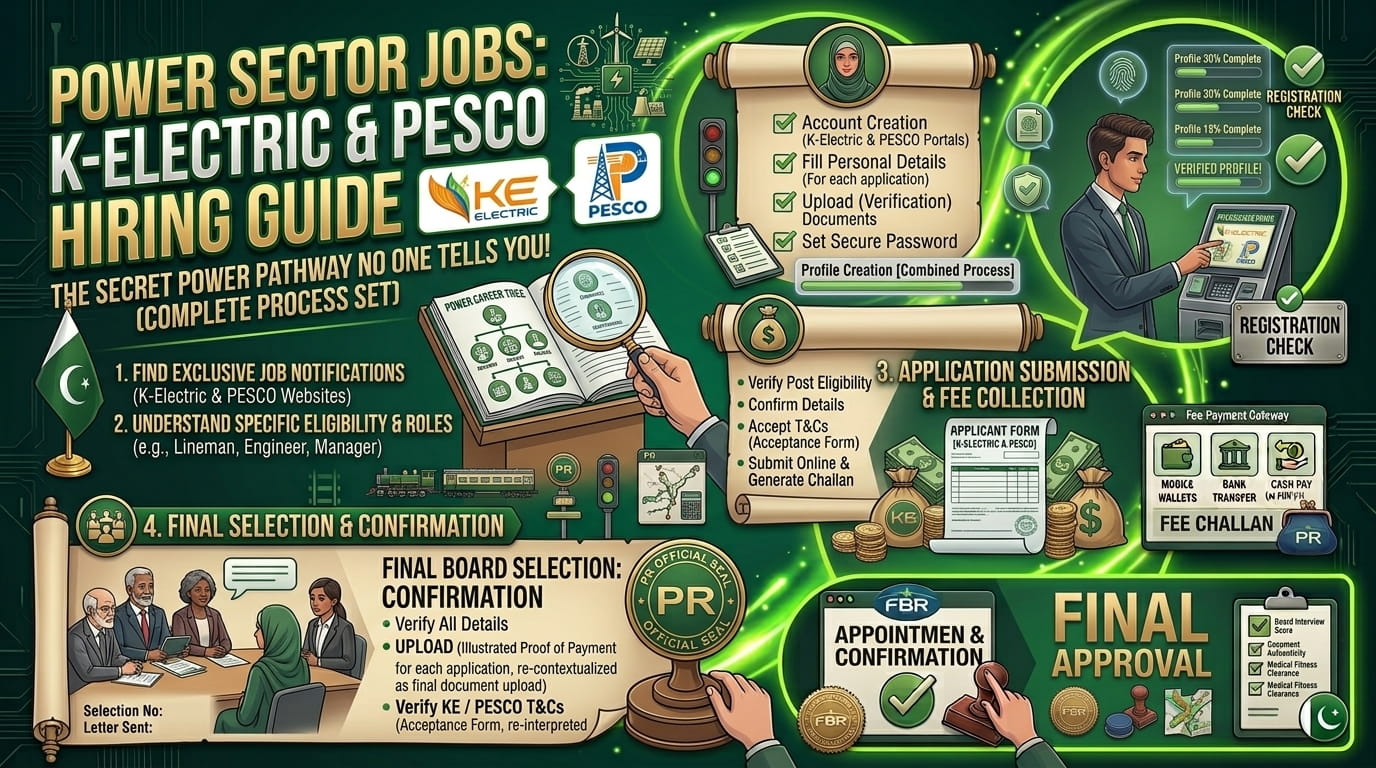
Same industry, same country, completely different hiring planet — that’s the honest way to describe applying to K-Electric versus PESCO. One feels like walking into a private multinational’s HR office. The other feels exactly like every other sarkari recruitment drive you’ve ever dealt with, domicile quotas included. Assume they work the same way, and you’ll waste an application finding out otherwise.
First — These Are Fundamentally Different Types of Organizations
This matters more than people realize going in. K-Electric (KE) is a privatized, vertically-integrated power utility — meaning it handles generation, transmission, AND distribution all under one company, exclusively serving Karachi and its adjoining areas (spanning 6,500 square kilometres, serving over 3.7 million customers across Karachi, Dhabeji, Gharo, and parts of Balochistan). It operates and hires like a private corporation.
PESCO (Peshawar Electric Supply Company) is one of WAPDA’s distribution company (DISCO) successors — a public sector power utility specifically distributing electricity across Peshawar and various KPK districts (Abbottabad, Mardan, Dera Ismail Khan, Kohat, Haripur, Bannu). It hires through standard government-style processes, complete with domicile quotas and testing agencies.
Knowing this upfront changes your entire approach — K-Electric hiring feels closer to applying at a private multinational; PESCO feels closer to applying for any other WAPDA-linked government post.
K-Electric: How Hiring Actually Works
Step 1: Apply directly through K-Electric’s official careers portal or LinkedIn.
Unlike PESCO, there’s no separate testing agency involved for most roles — you create an account directly on KE’s careers site, submit your CV, and apply to specific listed positions.
Step 2: Know that roles span the entire power value chain.
Current and recurring openings genuinely cover a wide range — from Generation (roles overseeing high-pressure boilers and turbines at power stations like BQPS), to Transmission and Distribution engineering, to Finance, Customer Service, and increasingly IT and data-related roles as KE modernizes its grid.
Step 3: For fresh graduates specifically, look for “GET” tagged roles.
K-Electric runs a Graduate Engineer Trainee (GET)-style program — search specifically for listings tagged this way on their careers page or on Rozee.pk and LinkedIn, since these are structured for entry-level engineering graduates rather than requiring years of prior experience.
Step 4: For engineering roles, have your PEC registration ready and clearly stated.
KE’s application forms for technical/engineering positions specifically ask you to state your PEC registration number upfront — get this sorted before applying seriously, same advice as with any engineering role in Pakistan’s power or construction sector.
Step 5: Prepare for a multi-stage technical process.
Zeeshan’s actual experience: a technical assessment covering power systems, thermodynamics, or automation concepts depending on the specific role, followed by a behavioral interview panel assessing problem-solving and safety-first alignment (genuinely important in this industry, given the physical risk involved in power infrastructure work), and finally a medical check-up and orientation before onboarding.
Step 6: Highlight specific technical tool/system experience where relevant.
For more specialized roles, KE’s listings specifically look for experience with things like SCADA systems, high-pressure equipment, or BI (Business Intelligence) tools — tailoring your CV to mention specific relevant systems you’ve worked with, even at a student/project level, genuinely helps stand out.
PESCO: How Hiring Actually Works
Step 1: Check PESCO’s official vacancies page directly.
Step 2: Identify which channel is handling that specific recruitment.
This is genuinely important, and varies by post level. Higher-grade, professional roles (Engineering, MBA, M.Com, MSc, Computer Science, Finance qualifications) are commonly routed through the NTS online portal specifically — applications submitted by hand or post directly to PESCO are explicitly not accepted for these NTS-administered drives. Some other specific departmental roles (like recent Market Implementation & Regulatory Affairs Department openings) instead use PESCO’s own downloadable application form submitted directly, so this genuinely varies by advertisement — check each one carefully.
Step 3: Confirm your eligibility and domicile quota.
PESCO recruitment typically invites applicants from across Pakistan — Punjab, Sindh, KPK, Balochistan, FATA, GB, and AJK — but allocated according to specific quota per province/region stated in the advertisement, similar to most WAPDA-linked recruitment.
Step 4: Understand most posts are contract-based with lump-sum pay.
This is a genuinely important detail to know upfront, similar to NADRA’s structure covered earlier. PESCO explicitly states that most current positions (SDO/Junior Engineer, Assistant Managers, Revenue Officer, IT-related roles) are purely on a contract basis with a lump-sum salary package, extendable based on satisfactory performance — with no regularization claim entertained in the future. Go in with this expectation clear from the start, not assuming automatic conversion to a permanent post.
Step 5: If applying via NTS, track your roll number slip through NTS directly.
Roll number slips get issued by NTS, not PESCO, before the test — you’ll also typically receive SMS alerts regarding your test schedule, and slips are downloadable from NTS’s own website.
Step 6: Note there’s no TA/DA for any recruitment stage.
PESCO explicitly states no travel/daily allowance is admissible at any stage of the process — worth factoring into your planning if you’re traveling from outside the immediate region for a test or interview.
Step 7: Only shortlisted candidates get contacted.
As with most large-scale government-adjacent recruitment, expect that only candidates who clear each stage get a direct call — don’t expect individual rejection notifications if you don’t make the shortlist.
A Real Comparison Worth Knowing
Zeeshan’s K-Electric application (a technical engineering role): entirely online through their careers portal, technical assessment focused on actual power systems knowledge, panel interview, medical check, and onboarding — process felt structured but distinctly corporate in tone, closer to applying at any private multinational engineering firm.
His PESCO application (an SDO/Junior Engineer contract post): NTS-administered written test, roll number slip via NTS’s own portal and SMS alerts, followed by an interview — process felt identical in structure to any other WAPDA-linked or FPSC-adjacent government recruitment, right down to the domicile quota checks and no-TA/DA policy.
Common Mistakes People Make
Assuming both companies hire the same way. As covered extensively above — K-Electric is a private corporate process; PESCO runs government-style, often through NTS. Treat each application completely separately.
Sending PESCO applications by hand/post when the ad explicitly requires NTS online submission. This is explicitly stated as unacceptable for those specific drives — always check whether NTS or PESCO’s own form is the correct channel for that particular advertisement.
Not having PEC registration ready for K-Electric engineering roles. As with most engineering positions in Pakistan’s power/construction sectors, this is expected to be stated clearly upfront, not something to sort out after an offer.
Expecting PESCO contract roles to auto-convert to permanent. As covered above, PESCO explicitly states no regularization claims are entertained — go in with the right expectation about the contract nature of the role.
Ignoring domicile/regional quota for PESCO specifically. Confirm your domicile matches the quota allocation for your target post before investing time in the application.
Not tailoring your CV to specific technical systems for K-Electric. Generic engineering CVs undersell you here — mention specific relevant tools, systems, or project experience (SCADA, thermal/power systems, BI tools) directly relevant to the listed role.
What to Realistically Expect Salary and Growth-Wise
K-Electric, being a larger private corporate structure with substantial ongoing investment in grid modernization and renewable energy integration, generally offers competitive private-sector-level packages, particularly for engineering and technical roles, along with more clearly structured long-term career growth pathways given its scale and investment plans. PESCO’s contract-based lump-sum packages vary considerably by post and grade, generally aligned with standard WAPDA-linked government pay structures — solid and stable, though typically more modest than equivalent private-sector power industry roles, with the trade-off being genuine government-sector job stability once retained.
Final Thoughts
Power sector hiring in Pakistan genuinely splits into these two very different worlds — K-Electric’s more corporate, structured private-sector process, and PESCO’s (along with the other WAPDA-linked DISCOs like LESCO, IESCO, MEPCO) government-style, often NTS-administered recruitment. The real key is treating each application on its own terms rather than assuming a shared approach works for both — know exactly which channel each specific advertisement wants, have your PEC registration ready if you’re an engineer, and go in with realistic expectations about contract-versus-permanent structures, especially for PESCO.
Zeeshan’s honest summary comparing both experiences: “KE mein professional corporate feel hai, PESCO mein sab kuch by-the-book sarkari process hai — dono achay hain, bas expectation sahi rakho ke kaunsa kaisa hai.” K-Electric has a professional corporate feel; PESCO is entirely by-the-book government process — both are good, just keep your expectations aligned with which is which.
Official portals worth bookmarking:
- K-Electric Careers: https://www.ke.com.pk/careers (also check their LinkedIn page for active listings)
- PESCO Vacancies: https://www.pesco.com.pk/vacancies
- NTS (for PESCO NTS-administered posts): https://www.nts.org.pk