
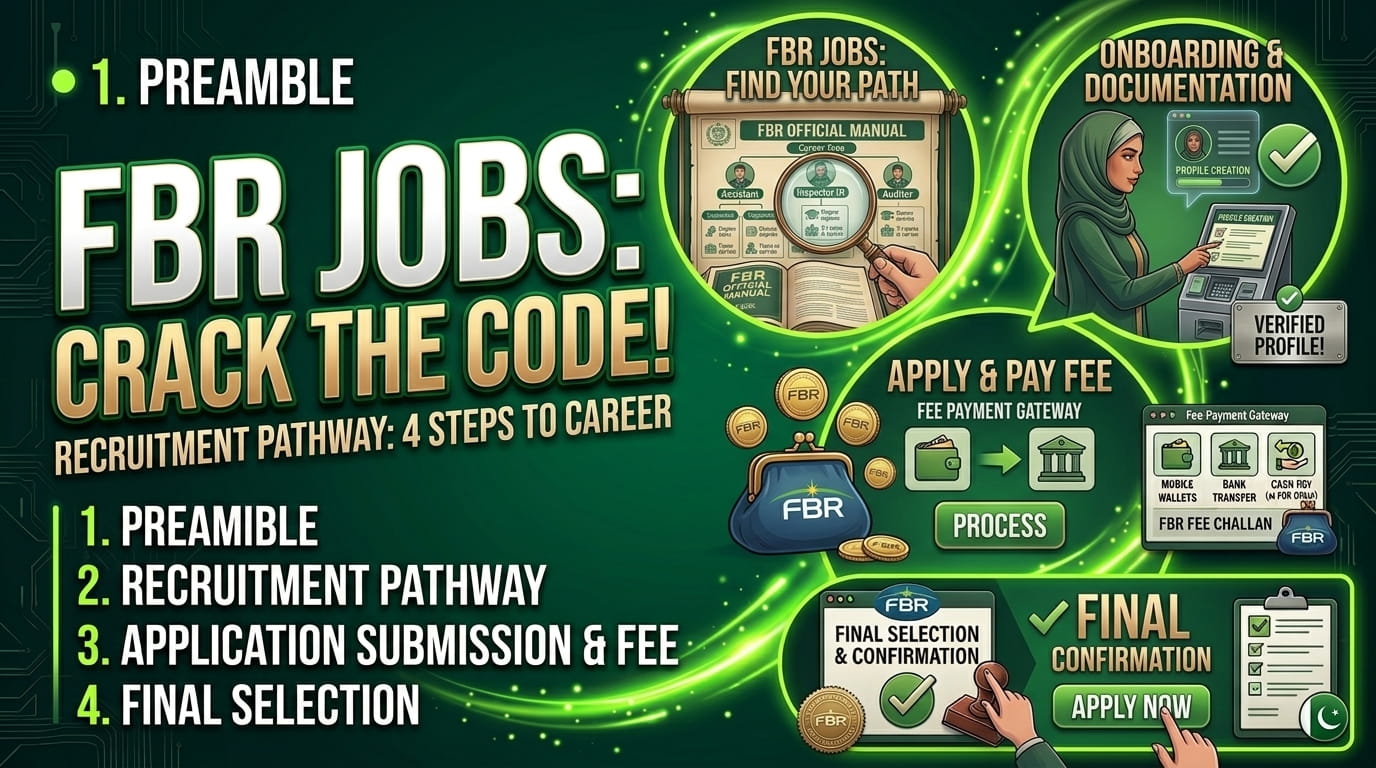
My khala’s beta, Fahad, has been eyeing an FBR Inspector post for over a year now. What genuinely surprised him when he first started looking into it: FBR itself doesn’t run its own hiring test the way you’d expect. He kept checking FBR’s own website for a “test date” and found mostly just advertisement PDFs — the actual testing and selection process runs through FPSC (and sometimes NTS or the National Job Portal, depending on the specific post tier).
That confusion cost him a missed application window on his first attempt — the FPSC deadline had already passed by the time he realized where he actually needed to apply. Second time around, he tracked it properly and made it through to the interview stage. Here’s the honest, complete picture of how FBR hiring actually works, across the different post levels.
First — Understand FBR’s Structure and Why Roles Vary So Much
FBR (Federal Board of Revenue) is the government body responsible for tax collection, customs regulation, and financial compliance nationwide. Because it handles both Inland Revenue (income tax, sales tax) and Customs separately, plus enforcement and administrative wings, the range of posts is genuinely wide — and each tier has a different path in.
Inspector-level posts (BS-16) — Inspector Inland Revenue, Inspector Customs/Intelligence Officer. These are the more competitive, career-track entry points, typically requiring a Bachelor’s degree (at least Second Class) in a relevant field like Economics, Commerce, Accounting, Statistics, Law, or a related discipline.
Assistant/Clerical posts (LDC, UDC — Lower/Upper Division Clerk) — lower entry barrier, generally Intermediate or Bachelor’s level depending on the specific post, often including a typing/data entry skill requirement.
Sepoy and Sub-Inspector posts (Customs enforcement side) — these often run on a contract basis (commonly cited as 2-year contracts), advertised separately and sometimes routed through the National Job Portal rather than FPSC directly.
IT and specialized administrative roles — increasingly common as FBR digitizes its systems, these can carry different eligibility tracks entirely, sometimes hired more directly rather than through FPSC’s standard testing route.
Step-by-Step: How to Actually Apply
Step 1: Know which body is actually running the specific recruitment.
This is exactly where Fahad went wrong initially. Most Inspector-level FBR posts (Inland Revenue and Customs) are advertised and tested through FPSC — https://www.fpsc.gov.pk. Lower-tier posts (Sepoy, some clerical roles) sometimes go through the National Job Portal (njp.gov.pk) or occasionally NTS, depending on the specific advertisement. Always check the specific FBR advertisement PDF itself — it states clearly which agency is handling the test for that particular post.
Step 2: Check FBR’s own website for the announcement first.
Step 3: Confirm your eligibility for the specific post carefully.
For Inspector Inland Revenue/Customs (BS-16): a Bachelor’s degree, generally at least Second Class, in Economics, Commerce, Accounting, Statistics, Law, Pharmacy, Chemistry, Physics, Computer Science, or Engineering — candidates with higher qualifications or relevant experience are often preferred, though experience typically isn’t mandatory. Age limit commonly sits around 21-28, with the standard government employee relaxation extending it up to around 35 for those already serving in government roles.
Step 4: Register and apply on the correct portal — FPSC for most Inspector posts.
Create your profile on FPSC’s application system, select the correct advertisement and post, and fill in your details accurately. As with any FPSC application, read the full advertisement for exact qualification and domicile requirements before submitting.
Step 5: Pay the application fee correctly.
Fee amounts vary by post grade — commonly in the low hundreds of rupees for BS-16 posts through FPSC, paid through the specified bank challan or online payment method stated in that specific advertisement.
Step 6: Check domicile-based quota allocation.
FBR/FPSC seats are allocated by province and domicile quota — Fahad specifically had to confirm his domicile matched the province he was applying under, since seats aren’t simply first-come-first-served across the whole country. Vacancies are typically available across all provinces and regions (Punjab, Sindh, KPK, Balochistan, FATA, AJK, Gilgit-Baltistan), but allocated by specific quota, not a flat open pool.
Step 7: Prepare seriously for the written test.
The test typically covers English, General Knowledge, Current Affairs, Pakistan Affairs, and subject-related questions tied to your specific post. FPSC past papers (available through their own resources and reputable prep platforms) give a genuinely accurate sense of question style and difficulty — more reliable than generic prep content not specific to FBR/FPSC’s actual pattern.
Step 8: Download your roll number slip and attend the test.
This gets issued through FPSC’s portal once your application is processed — bring it along with your original CNIC to the test center, same as any FPSC-administered exam.
Step 9: Attend the interview if you clear the written stage.
Expect questions on your subject background, general awareness, and scenario-based questions relevant to tax/customs enforcement work — panels do probe for ethical judgment and attention to detail specifically, given the nature of the role.
A Real Detail Worth Knowing: Women’s Quota and Age Relaxation
FBR and FPSC reserve a specific percentage of seats for women candidates, and female applicants are genuinely encouraged to apply — worth checking the exact quota percentage in each specific advertisement, since it can vary by post. Separately, if you’re already a government employee, you typically get an age relaxation of a few years (commonly up to 5), pushing your effective upper age limit higher than the standard listed limit — don’t rule yourself out without checking this if you’re already in government service elsewhere.
What to Realistically Expect Salary and Timeline-Wise
Inspector-level posts (Customs/Inland Revenue) typically start somewhere around PKR 60,000–80,000/month, including additional allowances on top of base pay — a genuinely solid starting package by general government-sector standards, reflecting the seniority and responsibility of BS-16 roles. Lower-tier Assistant/clerical posts start more modestly, while Sepoy and contract-based enforcement roles vary depending on the specific terms of that recruitment cycle.
From application to final appointment, the whole process typically takes 6 to 12 months, depending on FPSC’s schedule for that particular cycle — this isn’t a fast process, and building that expectation in early saves a lot of frustrated checking of the portal.
Common Mistakes People Make
Applying through the wrong portal entirely. As covered above, this was Fahad’s actual first mistake — always check the specific advertisement for which agency (FPSC, NTS, or National Job Portal) is handling that particular post’s testing.
Assuming a national vacancy pool instead of checking domicile quota. Confirm your domicile matches the province/region quota for your target post before applying.
Not checking the age relaxation if already a government employee. This genuinely extends eligibility for a meaningful chunk of applicants who might otherwise assume they’re over the limit.
Skipping proper past-paper preparation. The written test genuinely tests specific, learnable content (English, GK, Current Affairs, Pakistan Affairs, subject knowledge) — treating it casually is a common, avoidable reason for not clearing this stage.
Missing the application window because of confusion over testing agency. Track the specific deadline on the correct portal directly, not just FBR’s initial announcement date.
Relying on unofficial job sites for deadlines and requirements. A lot of recycled or outdated FBR job content circulates online — always confirm current details directly against FPSC’s or FBR’s own official notices before finalizing anything.
Final Thoughts
FBR remains one of the more genuinely prestigious and stable federal career paths available to graduates in Pakistan — strong salary packages relative to entry-level government pay, real authority and responsibility, and long-term job security with pension benefits. The actual barrier isn’t the difficulty of the role itself, it’s understanding the layered system correctly — knowing which agency runs your specific post’s test, checking your domicile quota, and preparing properly for a written exam that genuinely rewards real preparation over guesswork.
Fahad’s honest reflection after his second, more successful attempt: “Pehli baar maine socha FBR ki site pe hi sab kuch mil jayega. Doosri baar samajh aaya ke FPSC hi asal jagah hai jahan dhyaan dena hai.” The first time, he assumed everything would be on FBR’s own site. The second time, he understood FPSC was actually where the real attention needed to go — and that single realization is what got him past the stage he’d missed before.
Official resources worth bookmarking:
- FBR Official Website: https://www.fbr.gov.pk
- FPSC (for most Inspector-level testing): https://www.fpsc.gov.pk
- National Job Portal (for some lower-tier/contract posts): https://njp.gov.pk