
My phupho’s beta, Usman, applied for a PPSC post last year without reading the eligibility section properly — assumed his Bachelor’s degree qualified him for a role that actually wanted a Master’s with a specific subject specialization. He didn’t even get a test call, and it took him a while to figure out why, since the rejection notification doesn’t exactly explain itself. Second attempt, he actually read the advertisement like it was a legal document, line by line, and made it through to the interview stage.
I’ve been through PPSC’s website with him more than once now, and it’s honestly a much more straightforward system than people expect once you know the actual steps — the confusion mostly comes from not knowing where to look and what to check first. Here’s the real, complete process.
First, Understand What PPSC Actually Covers
PPSC — Punjab Public Service Commission — is responsible for recruiting for provincial government departments across Punjab, through a merit-based process of written exams and interviews. It covers a genuinely wide range: administrative posts, education department roles (lecturers, teachers), health department positions, engineering roles, police-adjacent posts, and general administrative/clerical positions — spanning from BS-11 up to BS-18 depending on the specific advertisement.
There’s one route worth knowing specifically: PMS (Provincial Management Service) — this is Punjab’s version of a competitive civil service exam, similar in structure to CSS but at the provincial level, leading to Assistant Commissioner-level BS-17 posts and above. It’s a 1200-mark exam split between compulsory and optional subjects, run through its own dedicated PPSC advertisement, separate from regular recruitment drives. If you’re aiming for something CSS-adjacent but want to stay within Punjab specifically, PMS is the route to look into.
Step-by-Step: The Actual Application Process
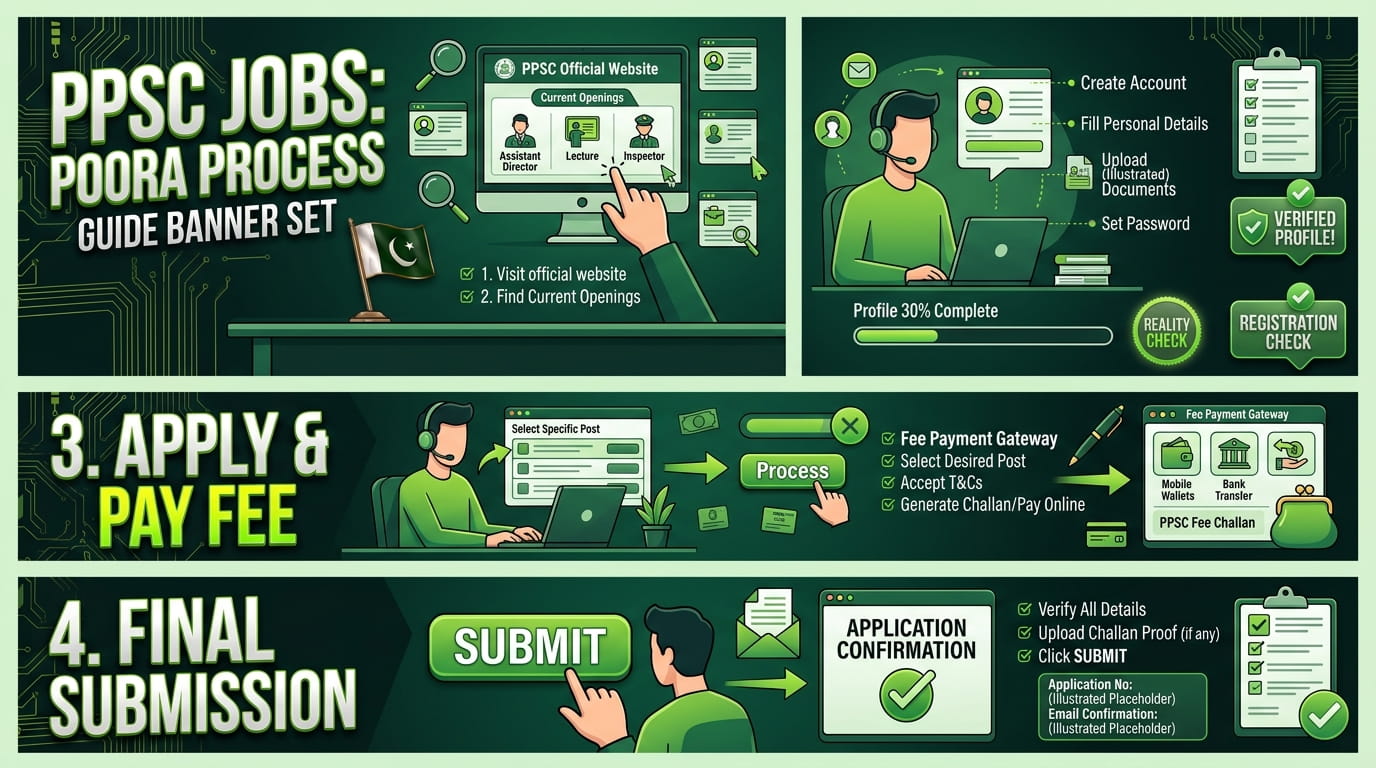
Step 1: Go straight to the official PPSC website.
Step 2: Find the relevant advertisement and read the entire document — not just the post title.
PPSC publishes numbered “Advertisements” (like Advertisement No. 06/2026 or 08/2026), each covering multiple departments and posts simultaneously in one mega-recruitment drive. This is exactly where Usman went wrong the first time — he saw a post title that sounded right and applied without checking the specific qualification line underneath it. Read the eligibility criteria, age limit, qualification requirement, and domicile condition for your specific post of interest, every single time.
Step 3: Check the domicile requirement carefully.
Most PPSC posts are open “All Punjab Basis,” meaning any Punjab domicile holder can apply. But some specific posts are restricted to a particular district’s domicile only — for example, certain roles have been reserved specifically for a named district’s residents even within a broader province-wide advertisement. Don’t assume every post in a Punjab-wide ad is open to all of Punjab; check each post’s specific line.
Step 4: Register and apply directly on the PPSC portal — no separate pre-registration needed.
One genuinely convenient thing about PPSC’s current system: you don’t need to create a separate account or build a profile beforehand the way some other systems require. You apply directly for the specific advertisement through the online application system on their website when it’s live.
Step 5: Fill out the application form completely and accurately.
Double-check your personal details, academic qualifications, and domicile information before submitting — PPSC verifies these later, and mismatches or incomplete sections are a common, avoidable reason for early rejection.
Step 6: Pay the application fee through an approved method.
PPSC has phased out manual bank challans — when you apply online, the system automatically generates a PSID (Payment Slip ID), which you then pay through approved channels: ATMs, mobile/internet banking, over-the-counter at 1Link member banks, or directly through JazzCash, EasyPaisa, UPaisa, and similar approved mobile wallets. This is genuinely more convenient than the old physical-challan system, and fees vary by post — some specific exams like PMS have listed a flat fee (around Rs. 1,000 per application), while general recruitment posts often have lower, post-specific fees.
Step 7: Prepare for the written test using the official syllabus.
PPSC publishes the syllabus for each specific test directly on their website — download and study from this rather than guessing based on generic “PPSC prep” content, since the actual paper structure and subject weightage is laid out clearly in the official document for each specific post.
Step 8: Track your application, roll number slip, and test schedule through the portal.
Check the “Notices” section regularly for updates — roll number slips, test date changes, and interview call letters all get posted here. Usman’s advice from his own experience: check the site every few days during an active application cycle rather than waiting for a notification, since PPSC doesn’t always send personal reminders for every update.
Step 9: Attend the interview stage, if you clear the written test.
For general recruitment posts, expect a panel interview focused on your academic background, general awareness, and sometimes department-specific knowledge. For PMS specifically, expect a more rigorous interview given the higher-stakes nature of the exam, similar in tone to CSS interviews.
Step 10: Check your result through the portal using your CNIC.
PPSC regularly updates written exam results, typing test results (for clerical posts), and final merit lists directly on their site — you can check your status by entering your CNIC on the results page, without needing to search through a separate PDF list manually.
A Real Example Worth Knowing
Usman’s actual successful application: a BS-16 post under a recent Punjab-wide advertisement, requiring a specific Master’s-level qualification, open on an All Punjab domicile basis. He applied online, paid the fee via EasyPaisa (genuinely simple, took about two minutes), downloaded the official syllabus PDF for his specific post, and prepared using actual past papers rather than generic prep content. Written test, then interview, then a merit-list-based final result — the whole process from application to final result took around 4 months.
Common Mistakes People Make
Applying without matching your exact qualification to the post’s specific requirement. As covered above, this is the single most common, entirely avoidable rejection reason — a subject specialization or degree-level mismatch gets filtered before you even reach the test stage.
Assuming domicile rules are uniform across a whole advertisement. Some posts within the same numbered advertisement have different, more restrictive domicile conditions — check each post individually.
Using an unapproved payment method for the fee. Stick to the specific channels listed in your PSID/payment instructions — ATMs, approved mobile banking, or 1Link banks.
Not downloading and studying the official syllabus. Generic prep content doesn’t always match the actual weightage and structure PPSC has published for your specific test — always go to the source document.
Missing update notices due to infrequent portal checks. PPSC posts important updates directly on their site’s Notices section — check in regularly during any cycle you’ve applied to, rather than expecting a personal reminder.
Confusing regular recruitment with PMS. These are genuinely different processes with different exam structures and stakes — know which one you’re actually preparing for, since prep strategy differs significantly between the two.
What to Realistically Expect Timeline and Outcome-Wise
For regular PPSC recruitment posts, the process from application to final result commonly runs around 3-6 months, similar to FPSC’s general recruitment timeline. PMS, given its scale and multi-stage structure, takes longer and is considerably more competitive, closer to CSS in intensity though generally with better odds since you’re competing within Punjab specifically rather than nationally.
Final Thoughts
PPSC’s process genuinely has gotten more streamlined over the past few years — fully online applications, no separate pre-registration hassle, and digital payment options that actually work smoothly through apps most people already use daily. The real skill isn’t navigating complicated bureaucracy — it’s discipline in reading each specific advertisement’s requirements carefully before applying, and treating the syllabus and past papers as your actual prep foundation rather than random online content.
Usman’s honest takeaway after his successful second attempt: “Pehli baar maine socha bas apply kar do, dekhte hain. Doosri baar maine har cheez, har line, dhyaan se parhi.” The first time, he thought just applying and seeing what happens was enough. The second time, he read every single line carefully — and that’s genuinely the whole difference between a rejection and a test call.
Official portal to bookmark and check regularly:
- PPSC Official Website: https://www.ppsc.gop.pk